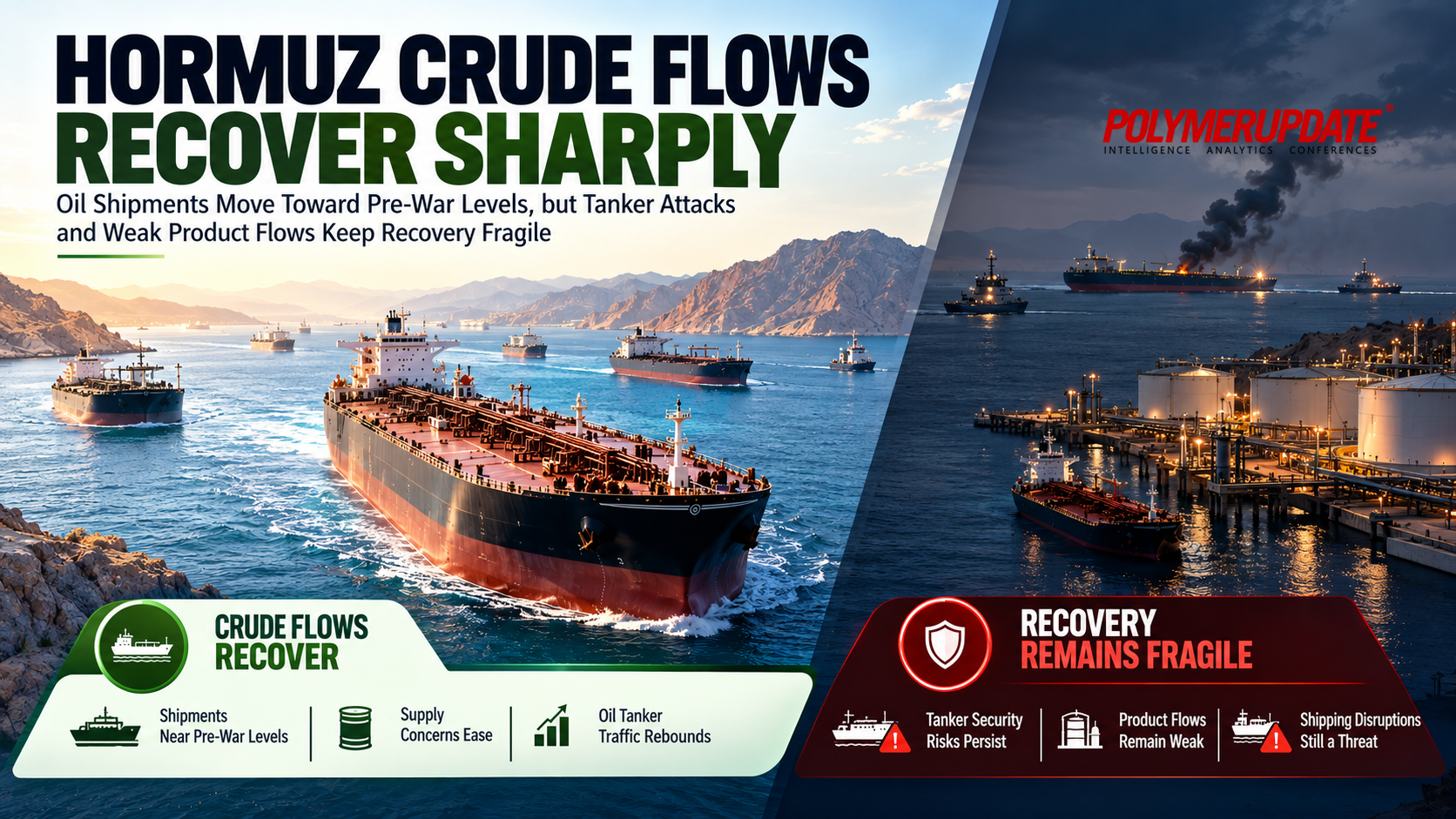
Crude oil flows through the Strait of Hormuz have recovered sharply in recent weeks after months of severe disruption caused by the United States-Iran conflict, with shipments approaching pre-war levels. Experts believe vessel movements have recovered to around 80–85 percent of the number of oil tankers and merchant ships that transited the strategic waterway in January 2026, a month before the US and Israel began joint strikes on Iran on February 28, 2026. However, the recovery remains fragile, as attacks on commercial vessels continue to pose a significant threat to one of the world’s most important energy corridors.
Reports quoting tanker-tracking firm Kpler said the seven-day moving average of crude shipments through the Strait of Hormuz reached around 13.5 million barrels per day (bpd) as of September 28, while combined crude and petroleum product flows stood at around 14.2 million bpd. This was equivalent to roughly 80 percent of the pre-war baseline of about 17 million bpd. Other measures indicate that crude and petroleum product flows through the waterway have recovered to between 13.1 million bpd and 13.5 million bpd, compared with an estimated 17–20 million bpd before the conflict. The latest data point to a substantial restoration of trade despite continued military and shipping risks.
 Regional supply trend
At the broader regional level, however, crude exports have been even stronger. Middle East crude exports, including shipments through the Persian Gulf and Red Sea, reached a seven-day average of around 19.5 million bpd in late September, above the pre-war baseline of approximately 17 million bpd. On several days during the final week of September, regional exports climbed to between 19.5 million bpd and 22.5 million bpd.
Kpler data showed that Middle East crude exports exceeded pre-war levels on September 24 and again between September 27 and 29. The seven-day average stood at approximately 18.5 million bpd on October 1, although the figure includes shipments through Hormuz, the Red Sea, export terminals and ship-to-ship transfers in the Gulf of Oman. The recovery suggests that producers and shipping companies have developed alternative mechanisms to keep crude moving despite the conflict.
U.S. naval escorts and patrols have helped provide greater protection to commercial vessels, while regional producers have increasingly relied on ship-to-ship transfers and alternative export routes. The United Arab Emirates, for example, has used shuttle-tanker operations in which vessels load cargo inside the Persian Gulf, cross the Strait of Hormuz and transfer their cargo to waiting tankers outside the waterway. Such operations reduce the amount of time large export vessels spend in the most exposed areas.
Alternative routesPipelines have also assumed a greater role. Saudi Arabia's East-West pipeline provides an alternative route from the country's eastern oil-producing areas to the Red Sea, while the UAE's pipeline system allows crude to reach Fujairah on the Gulf of Oman without passing through Hormuz. According to Kpler, around 40 percent of Gulf crude oil is now bypassing the Strait through alternative pipelines, compared with only about 17 percent before the war. The increased use of these routes has helped compensate for reduced maritime capacity and prevented a complete collapse in regional exports.
The composition of flows through Hormuz highlights the strategic importance of the waterway to global energy markets. Saudi Arabia accounts for about 37.2 percent of the crude and petroleum volumes passing through the strait, followed by Iraq at 22.8 percent, the UAE at 12.9 percent, Iran at 10.6 percent and Kuwait at 10.1 percent. On the demand side, Asia remains overwhelmingly dependent on the waterway. Asian economies account for approximately 89.2 percent of crude and condensate passing through Hormuz. China is the largest destination with around 37.7 percent, followed by India at 14.7 percent, South Korea at 12 percent and Japan at 10.9 percent.
Advantage IndiaFor India, the restoration of flows is particularly important because the country imports around 85–88 percent of its crude oil requirements. A prolonged disruption in Hormuz would increase freight and insurance costs, lengthen supply routes and potentially raise the landed cost of crude for Indian refiners. The recovery in crude flows, however, has not been matched by refined petroleum products. Refined product shipments through Hormuz remained severely depressed at around 677,000 bpd in the seven days to September 28, compared with approximately 3.6 million bpd before the conflict.
The disparity is significant because a sustained shortage of refined products, particularly diesel, can exert pressure on fuel markets even when crude supplies begin to recover. Tight product availability has already contributed to elevated diesel prices in the United States, raising concerns about inflation and economic growth. The disruption has also prompted debate in Washington over whether restrictions on U.S. fuel exports may be required to protect domestic supplies. Any such measure could have wider implications for international product markets because the United States is a major exporter of refined petroleum products.
OPEC+ in actionMeanwhile, the Organisation of the Petroleum Exporting Countries and its allies (OPEC+) are assessing market conditions as they determine their next production steps. The seven core OPEC+ members pumped around 25 million bpd in August, an increase of approximately 630,000 bpd from July, but still around 5 million bpd below pre-war levels in February. Although OPEC+ has been raising production targets during much of 2026 following years of supply restraint, actual output increases have lagged the announced targets.
The Middle East conflict, infrastructure disruptions and logistical constraints have prevented producers from fully translating higher quotas into physical supply. The apparent recovery in exports therefore masks continuing vulnerabilities in the global oil market. The Strait of Hormuz normally handles about 125 large commercial vessels a day, including oil tankers, gas carriers, bulk carriers and container ships. Before the conflict began on February 28, the waterway carried roughly one-fifth of global crude oil and liquefied natural gas supplies.
HeadwindsHowever, challenges remain in terms of shipping security which proves as the biggest threat to the recovery. At least seven incidents involving tankers have been reported in and around Hormuz, according to maritime intelligence. The very large crude carrier Kazimah III was reportedly struck by an unidentified projectile on October 1 while operating in the strait, triggering a fire. All crew members were subsequently evacuated and reported safe. The United Kingdom Maritime Trade Operations agency has also reported at least one attack a day in the Strait of Hormuz or Gulf of Aden since October 2.
Maritime security analysts have warned that the threat may be increasingly unpredictable. Rather than deliberately targeting individual merchant vessels, Iranian forces may be firing missiles into designated engagement areas, or "kill boxes", where vessels can be exposed to weapons that acquire available radar signatures. This raises the risk that even vessels not directly involved in the conflict could become collateral targets simply by entering an exposed area.
Reducing immediate supply riskDespite these risks, the latest export figures demonstrate the resilience of Middle East oil supply chains. Producers have combined military escorts, alternative pipelines, shuttle-tanker operations, ship-to-ship transfers and rerouting to restore a substantial portion of lost capacity. For the oil market, the recovery reduces the immediate risk of a complete supply shock and could place a mild bearish pressure on crude prices if the trend continues. However, the market is unlikely to fully price out the geopolitical premium while attacks persist and refined-product flows remain constrained.
Crude prices are therefore likely to remain highly volatile and headline-driven in the near term. A sustained improvement in Hormuz traffic, further restoration of Middle East production and greater use of bypass pipelines could push prices lower. Conversely, any major tanker attack, renewed closure of the strait or disruption to alternative export infrastructure could rapidly revive the supply risk premium.
The central question for the global oil market is no longer simply whether crude can move through Hormuz, but whether those flows can remain secure. Until there is greater confidence on shipping safety and refined-product availability, the recovery in physical crude exports is unlikely to eliminate the underlying risk premium from international oil prices.
DILIP KUMAR JHA
Editor
dilip.jha@polymerupdate.com