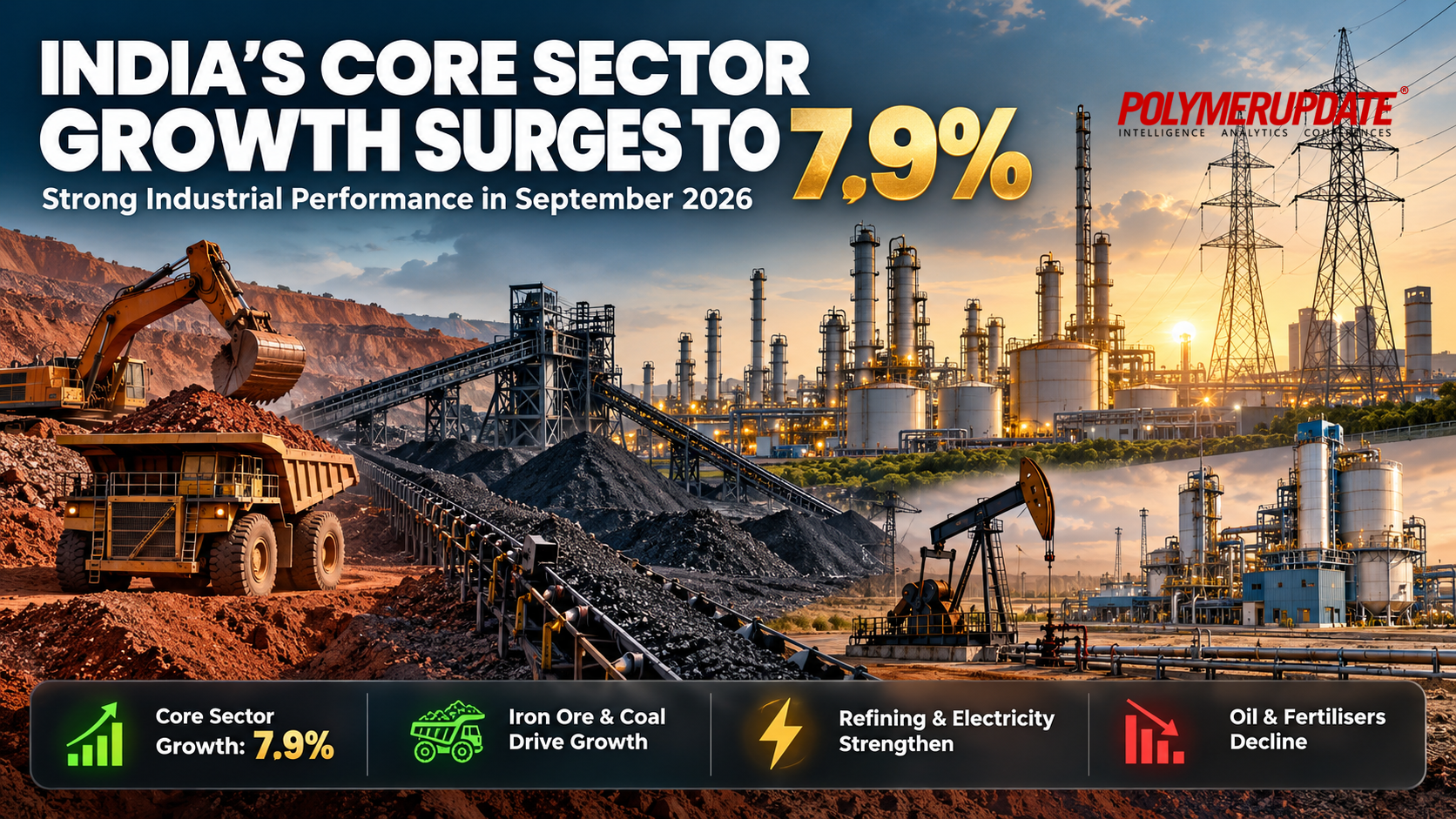
India’s core infrastructure industries recorded their fastest growth in the current data series in September and marked the highest expansion in 30 months due to an improvement in industrial activity and infrastructure-related demand, although the performance remained uneven across sectors. Data compiled by the Ministry of Commerce and Industry showed India’s Index of Core Industries (ICI) at 7.9 percent year-on-year in September 2026, accelerating from a revised 5.9 percent in August and significantly outperforming the 3.1 percent growth recorded in September 2025.
The latest expansion was driven by a strong recovery in iron ore and coal production, alongside robust growth in refinery products and electricity generation. The September performance also strengthened the cumulative growth trajectory for the current financial year. Core sector output expanded 5.1 percent during April-September 2026, more than double the 2.5 percent growth recorded during the corresponding period of the previous year.
According to an economist of a leading financial institution, “The improvement is significant for an economy in which infrastructure investment, construction, manufacturing and energy consumption are important drivers of growth. However, the latest figures also underline the need to distinguish between a strong headline growth rate and a broad-based, sustainable recovery in industrial production. Higher availability of the raw material can support exports of finished goods, although the extent to which it translates into stronger domestic production depends on demand, capacity utilisation and inventory movements.”
 Strong performance across major industries
Iron ore production emerged as the strongest performer among the eight core industries, registering growth of 18.4 percent in September. Electricity generation increased 11.4 percent, while coal production rose 10.7 percent. Refinery products output expanded 10.3 percent, cement production grew 9.8 percent, and steel output increased 4.9 percent. These six sectors recorded positive growth, while crude oil, natural gas and fertiliser production contracted during the month. The sharp expansion in iron ore production is significant for the steel industry, mining activity and associated transportation services.
Coal production also rebounded strongly, providing support to electricity generation and industrial energy requirements. The increase in electricity output points to sustained power demand, which is closely linked to manufacturing, commercial activity, household consumption and weather conditions.
Refinery products recorded a series-high growth rate of 10.3 percent in the current index series, following a comparatively weaker performance in the year-earlier period. Higher refinery output can reflect stronger domestic fuel demand, export opportunities and changes in refinery operations.
However, production growth alone does not establish the strength of end-user demand, as refinery throughput is also influenced by product exports and operational factors. Cement and steel production continued to expand, indicating resilience in construction and infrastructure-related activity. Nevertheless, steel output growth of 4.9 percent was more moderate than the expansion in several other industries, suggesting that the improvement was not equally strong across all major industrial inputs.
Historical comparison highlights recoveryThe latest figures mark a substantial improvement over the beginning of the current financial year, when core sector growth was subdued. The combined index increased by just 1.7 percent in April 2026, while the final growth rate for March was revised to 1.2 percent. The subsequent acceleration suggests that the weakness observed at the end of the previous financial year did not persist uniformly across the first half of FY27. The April-September growth rate of 5.1 percent, compared with 2.5 percent a year earlier, points to a stronger underlying production trend.
However, the comparison also requires caution. September's year-on-year expansion was partly supported by a favourable base effect, particularly in sectors such as coal and iron ore. When production in the corresponding month of the previous year is relatively weak, the subsequent annual growth rate can appear unusually strong. Moreover, the August growth rate was revised upwards to 5.9 percent from the provisional estimate of 4.8 percent, highlighting the importance of examining revised data rather than relying exclusively on initial monthly estimates.
The government introduced a revised core sector series with a base year of 2022-23, covering nine industries in the latest release. This differs from the earlier eight-industry framework, which used a 2011-12 base year. Historical comparisons across the two series therefore need to account for differences in coverage and methodology. Within the new series, September's 7.9 percent expansion represents the strongest growth rate since its introduction in April 2024.
Weakness in energy and fertiliserDespite the headline improvement, three industries continued to record negative growth. Crude oil production declined 1.4 percent year-on-year in September, natural gas output fell 4.6 percent, and fertiliser production contracted 11.7 percent. The decline in domestic crude oil production is particularly relevant for India, given its heavy dependence on imported petroleum. Persistent weakness in domestic output limits the scope for reducing import dependence and leaves the economy vulnerable to international oil price fluctuations, geopolitical disruptions and exchange-rate movements.
Lower natural gas production can also affect the availability of domestic fuel for power generation, industrial consumers and the fertiliser sector. The impact depends partly on imports, inventories, allocation priorities and demand conditions. The contraction in fertiliser production raises concerns for agricultural input availability, although imports and inventory management can help bridge supply gaps. Prolonged weakness could increase pressure on fertiliser imports and government subsidy expenditure, depending on international prices and domestic demand. These divergences demonstrate that stronger industrial output does not automatically translate into improved energy security or reduced dependence on imported raw materials and fuels.
Implications on GDPThe acceleration in core sector output could provide an important boost to India's broader industrial production and economic growth in the second half of FY27. The nine industries in the revised index account for roughly one-third of the country's industrial production, making the indicator an important early signal of manufacturing and infrastructure activity. Stronger steel, cement, coal and electricity output generally supports construction, transport, power-intensive manufacturing and capital goods industries.
If sustained, this momentum could translate into higher capacity utilisation, improved business confidence and stronger demand for industrial machinery, metals and other intermediate goods. The impact on gross domestic product (GDP), however, will depend on whether the improvement extends beyond infrastructure-linked industries to consumer goods, private investment and services. Core sector data provide an indication of production trends, but cannot by themselves establish the pace of overall economic expansion.
OutlookThe latest numbers could also influence the Index of Industrial Production (IIP), which captures a broader range of industrial activities. A sustained rise in core output would strengthen the outlook for industrial production, although weakness in non-core manufacturing segments could limit the overall gains.
DILIP KUMAR JHA
Editor
dilip.jha@polymerupdate.com