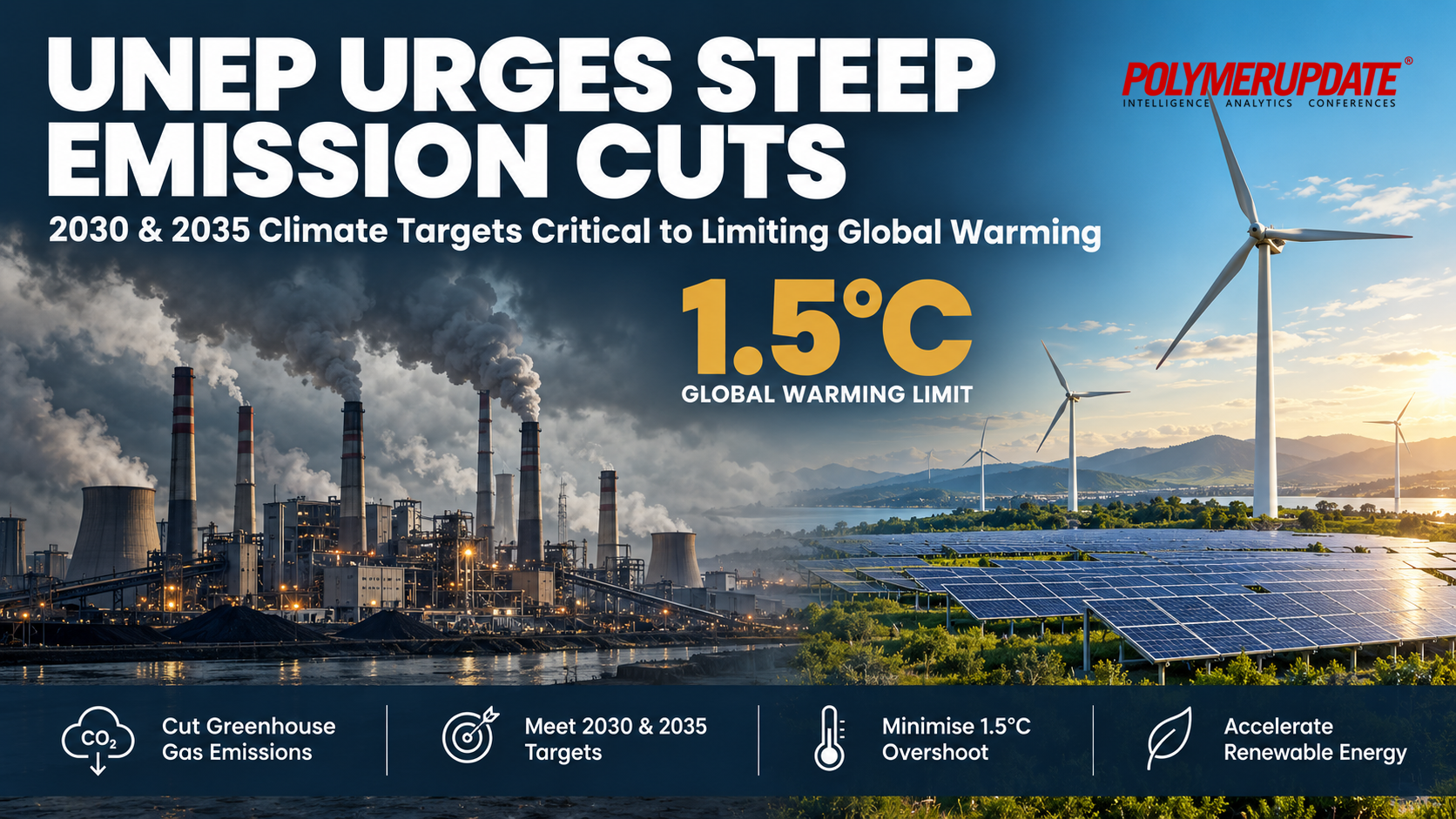
The United Nations has called for urgent and stringent cuts to greenhouse gas emissions (GHG) to minimize the magnitude and duration of overshoot and return to 1.5°C temperature growth by the end of the current century. The immediate attention is drawn in the wake of estimated exceed in the global temperature beyond the threshold of 1.5°C, a report released by the United Nations Environment Programme (UNEP) reads.
The report titled “The Emissions Gap Report 2026: The Point of Return” looks at a ‘lowest possible’ 1.5°C overshoot scenario, in which peak warming by around the middle of the century is limited to 1.7-1.8°C and global temperature rise is returned to or below 1.5°C by 2100, with about a 50 percent chance. To get onto this pathway, global greenhouse gas (GHG) emissions would have to be reduced by 18 percent by 2030, 45 percent by 2035 and 69 percent by 2040, all relative to 2025 levels.
By contrast, the full implementation of Nationally Determined Contributions (NDCs) would only reduce emissions by 5-8 percent by 2030 and 11-15 percent by 2035, relative to 2025 levels. This implies average annual reduction rates of 5.7 percent for 2025-2035, higher than the old Sixth Assessment Report (AR6) pathways laid out by the IPCC, which required annual reduction rates of about 5 percent.
"Overshoot is not surrender. We can still keep it as small and as short as possible – and bring temperatures back below 1.5 degrees by the end of the century. The new Emissions Gap Report from the United Nations Environment Programme shows us what it will take: Cutting global greenhouse gas emissions by 18 percent by 2030 and 45 percent by 2035 – compared with 2025 levels," UN Secretary-General António Guterres said in a message on the report. "
 More opportunities than ever
However, the report finds that there are more opportunities than ever to accelerate action. Since the adoption of the Paris Agreement, renewable energy has boomed, total energy supply from coal and oil has grown slower than projected and climate policies have cut emissions in many places.
“Every additional fraction of a degree and additional year of warming above 1.5°C increases climate impacts and risks, such as the deadly floods, heatwaves and wildfires that have plagued many nations this year. So, we must pull out all the stops to minimize peak warming and return to 1.5°C by the end of the century. This is possible. We have a wealth of success stories showing that emissions can be cut quickly. It is now up to nations to urgently put in place policies that spark fast, deep and sustained emissions reductions, and put the world on track for a more stable climate and more stable economies and societies,” said Inger Andersen, Executive Director of UNEP.
Temperature projections still far too highThe report finds that if current policies continue, warming could reach 2.8°C within this century and increase thereafter. If all NDCs are delivered and similar efforts continue, warming will be limited to 2.6°C. These outcomes are worse than last year’s projections due to the withdrawal of the United States of America from the Paris Agreement and revised estimates of historical emissions. New NDCs submitted since last year’s report have made a negligible difference for these projections.
Even in the most optimistic scenario, where all NDCs plus additional net-zero targets are achieved, global warming would only be limited to 2.1°C in this century. Without urgent action, keeping peak warming below 1.7 to 1.8°C will quickly become impossible. Every five years of CO2 emissions at current levels pushes peak warming up by around 0.1°C.
In addition, the lowest possible 1.5°C overshoot scenario creates a need for the removal from the atmosphere and permanent storage of roughly 320 gigatonnes of CO2 (equivalent to around eight years of 2024’s global CO2 emissions) over the course of this century. However, socio-economic and technological challenges make the chances of achieving this uncertain.
Need for successful effortsReturning to or below 1.5°C can be done, particularly since there is growing evidence that climate policies across the world can and have reduced emissions. The report links the introduction or strengthening of climate-related policies to dozens of structural shifts in developed and developing countries, resulting in significant emissions reductions.
More than 220 policy evaluations provide further evidence of what works. Evaluated policies in the electricity sector reduced emissions by an average of 9 percent, while economic instruments, including carbon cap-and-trade schemes and carbon taxes, achieved reductions of 5-13 percent across sectors in the evaluation period considered. Yet these successes remain concentrated in specific sectors, countries and periods. Getting onto a lowest possible 1.5°C overshoot pathway requires replicating, extending, and sustaining these successes.
Accelerating implementationIn the first Global Stocktake (GST), nations agreed to triple renewable energy capacity and double the annual rate of energy efficiency improvements by 2030, transition away from fossil fuels in energy systems, reduce non-CO2 emissions, halt and reverse deforestation and forest degradation, and more.
However, recent rates of change across all indicators tracking absolute GHG emissions – including CO2 emissions in energy systems, road transport emissions, and non-CO2 emissions, notably methane emissions – are heading in the wrong direction. While current policy scenarios project that some of these emissions will stabilize by 2030, none show declines occurring at the pace and scale needed to minimize the magnitude and duration of overshoot of 1.5°C.
The second GST can build on the first by reaffirming priority mitigation action areas, extending quantified goals to 2035 and 2040, and making existing action areas more tangible through clearer and, where possible, quantified targets. The report provides a preliminary assessment of such extensions to 2035 and 2040, consistent with the lowest 1.5°C overshoot scenario.
Focus on renewable energy capacityFor the goal to triple global renewable energy capacity and double the annual rate of energy efficiency improvement, an extension to 2035 would imply at least tripling renewable electricity capacity and reducing primary energy intensity of GDP by at least 30 percent relative to 2025 levels. For 2040, these estimates increase to at least 4.5 times and at least 40 percent respectively.
The good news is that since the adoption of the Paris Agreement, global renewable electricity capacity has grown three times faster than anticipated, with solar PV build-out increasing seven times faster. A continuation of these trends, supported by additional policies, would bring the world on track to triple renewable energy capacity by 2030 and increase the share of wind and solar in electricity generation to levels consistent with the lowest possible 1.5°C overshoot scenario.
Extending the goal related to transitioning away from fossil fuels in energy systems would require globally reducing the share of coal, oil and gas in total energy supply by at least 55, 15 and 5 percent by 2035 relative to 2025. Reductions of at least 75, 30 and 35 percent would be required in 2040.
At the same time, electricity generation from coal would need to fall by at least 75 percent in 2035 relative to 2025 and be effectively phased out globally by 2040. Methane emissions would need to be at least 25 percent lower than 2025 levels by 2035 and at least 40 percent lower by 2040.
DILIP KUMAR JHA
Editor
dilip.jha@polymerupdate.com